
Table of Contents
Understanding Roof Vent Installation Cost in British Columbia
When homeowners ask about roof vent installation cost in British Columbia, several factors shape the final price. The type of vent—ridge vent or solar attic fan—is the biggest driver: a ridge vent installation is generally more budget-friendly, while a solar attic fan installation adds material and wiring expense. Other cost influences include roof slope, existing ventilation condition, whether repairs to the roof deck are needed and local labour rates.
British Columbia’s building codes, including Part 9 of the BC Building Code, mandate specific ventilation ratios for moisture control. These requirements can affect total project cost because non-compliant systems must be upgraded to meet code. Working with a trusted roofing contractor in Vancouver ensures the work satisfies code, preserves manufacturer warranty coverage and delivers long-term performance.
We recommend a complimentary roof inspection with Paragon Roofing BC to receive an accurate, site-specific quote. Estimates and pricing are subject to onsite inspection and may change after assessment.
1. Save with Ridge Vent Installation
Proper attic ventilation is essential for every home. In Vancouver’s damp coastal climate, controlling moisture and heat buildup prevents costly structural damage. One of the most effective and affordable solutions we recommend at Paragon Roofing BC is a ridge vent installation. This passive system, installed at the roof peak, uses natural convection to continuously expel hot, humid air. Because they have no moving parts, ridge vents are exceptionally durable, require almost no maintenance, and can last as long as your roof itself.
The primary benefit over powered or solar attic fan alternatives is long-term savings. A ridge vent installation carries a lower upfront cost and zero operating expenses, helping to reduce both summer cooling and winter heating bills by stabilizing attic temperatures. The RCABC’s Roofing Practices Manual identifies continuous ridge venting as a benchmark for balanced air exchange. For maximum savings and long-term performance, we ensure professional roof installation in Vancouver that aligns with these provincial standards, securing your manufacturer’s warranty.
While a solar attic fan installation can play a role in certain designs, it involves higher initial spending and mechanical components that may require future service. A properly installed ridge vent offers a resilient, low-maintenance alternative. To see the difference quality ventilation can make, claim your complimentary roof inspection today.
Estimates and pricing are subject to onsite inspection.
2. Energy Savings with Solar Attic Fans
While the initial roof vent installation cost may seem significant, the long-term energy savings from a solar attic fan can make it a financially sound decision. These units use integrated solar panels to power a fan that continuously exhausts superheated air from your attic space. By lowering attic temperatures, which can soar well above 40 °C in Vancouver’s summer months, the system reduces the workload on your air conditioning equipment. Data from the Government of British Columbia suggests that effective attic ventilation can lower a home’s cooling load by an estimated 10–30%, meaning your AC doesn’t have to fight that extra heat radiating down into your living spaces.
A key advantage of solar attic fan installation is its operational independence — because the fan runs on free solar energy, it requires no electrical wiring. This eliminates the ongoing electricity costs associated with traditional powered vents. Every hour of sunlight directly offsets potential cooling expenses. Drawing from our two decades of local experience, Paragon Roofing BC has observed that homes with a properly sized solar-powered attic fan often see a faster return on investment, as reduced energy bills compound over the hot season.
It’s important to note that a solar attic fan works in combination with other ventilation, so pairing it with a quality ridge vent installation creates a balanced system. Passive ridge vents allow fresh air to enter at the eaves while the solar fan actively expels hot air at the peak, maximizing airflow efficiency. The energy you conserve each summer makes the upgrade a typical contributor to a more sustainable home. Beyond the energy savings, the cost of installing a solar attic fan depends on several factors that we’ll explore next — Protecting Your Home. Building Your Family’s Future.
3. Stop Leaks with Professional Vent Sealing
If you’re looking into roof vent installation cost, you’re probably weighing whether professional sealing is worth it. Vents are a common leak source—flashing and seals degrade from Vancouver’s rain and temperature shifts. A DIY caulk job may last a season; our professional sealing uses durable materials with manufacturer warranties and meets RCABC roofing association standards, the BC benchmark. In Vancouver’s wet climate, from ridge vent installation to solar attic fan installation, proper sealing is critical to prevent interior damage and protect home value. Key benefits include:
- Warrantied, long-lasting seals
- Mould and decay prevention
- Energy efficiency maintained
- BC compliance assured
Professional vent sealing costs typically a few hundred dollars, a modest investment next to major leak repairs. We offer a complimentary roof inspection, backed by over 20 years of local experience, to spot vent issues early. Claim your complimentary roof inspection. Professional sealing is one part of a watertight roof; we identify other issues too.
4. Choose the Right Vents for High-Wind Areas
While adequate roof ventilation is essential for every home, high-wind zones demand a more careful approach. In these exposed areas, roof vent installation cost should always be weighed against long-term durability, as inferior vents can easily lift off or sustain damage during severe storms. We recommend selecting products specifically engineered with higher wind-load ratings to ensure your roof remains protected year-round.
When planning for ridge vent installation or solar attic fan installation in coastal and elevated regions, consider these wind-suitable options:
- Ridge vents: A preferred choice for metal roofs due to their integrated, low-profile design that hugs the roofline and sheds wind effectively.
- Solar attic fans: Self-powered units that maintain active ventilation, though they must be firmly anchored with reinforced flashing to endure gusting winds.
- Low-profile static vents: Compact, sealed units that minimize wind uplift while providing passive exhaust.
Proper sealing and flashing are critical for every vent type. Even a small gap can allow wind-driven rain to penetrate, leading to interior damage. The BC Building Code mandates that vents in exposed and coastal locations meet specific wind-uplift resistance standards, so always verify that your chosen products comply with the current British Columbia building code. With over two decades of local experience, our installers understand exactly how to select and secure wind-rated vents for Lower Mainland homes. The right vent choice leads to better performance and fewer callbacks. If you notice loose flashing or suspect your current vents are underperforming, we’re ready to help — claim your complimentary roof inspection today.
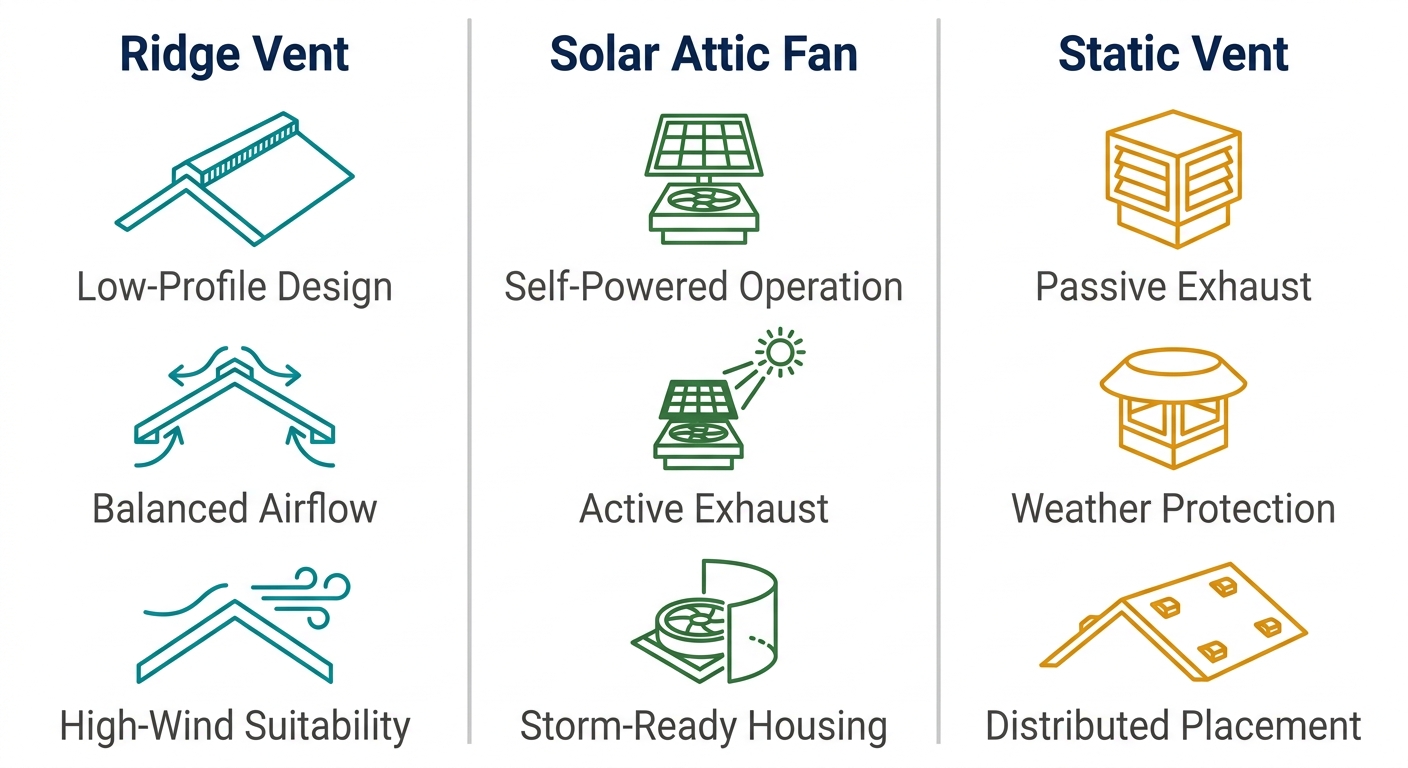
Wind-rated roof vent options: ridge vent, solar attic fan, and static vent comparison.
5. Extend Shingle Life with Proper Ventilation
Roof vent installation cost is a small price to pay when weighed against the long-term savings of a healthier roof. Replacing a roof is a major investment, and as we discussed in the previous section, a full roof replacement cost in Vancouver can range significantly. One of the most effective strategies to delay that expense is by ensuring your attic has a balanced ventilation system. Proper ventilation—an equilibrium of intake and exhaust—prevents the buildup of heat and moisture that silently ages asphalt shingles from below, causing them to curl, blister, and fail years before their time.
In our experience across the Lower Mainland, common upgrades that correct this issue include ridge vents, solar attic fans, and static vents. The Roofing Contractors Association of British Columbia (RCABC) provides clear benchmarks for minimum net free ventilation area, ensuring a home meets professional standards suited for our coastal climate. By investing in ventilation now, you essentially buy more years for your shingles without incurring the immediate expense of a full roof tear-off.
When we complete a complimentary roof inspection, identifying ventilation deficiencies is one of our team’s first priorities. Signs like overheated ceilings or musty attic air often point to a system that is out of balance. Once these needs are identified, our team can recommend and install the correct components efficiently—foreshadowing our next section on how we execute these upgrades. Protecting Your Home. Building Your Family’s Future.
6. Get the Vent Count Right for Your Attic
While roof vent installation cost matters, correct vent count is essential. Per the BC Building Code, use 1 square foot of NFVA per 300 square feet of attic floor (1:150 for damp/hot climates). Balanced soffit intake and ridge or gable exhaust prevent moisture buildup.
To calculate, divide your attic’s square footage by your chosen ratio. For a 1,200 ft² Vancouver attic, the 1:300 rule needs 4 ft², or 576 in², of NFVA. When planning ridge vent installation, a vent’s NFVA rating (e.g., 18 in² per linear foot) tells you the length needed, so divide 576 by 18 for about 32 linear feet. Ensure soffit intakes match that capacity. Solar attic fan installation adds active ventilation that can supplement passive vents, but local codes in Vancouver may still require the full 1:300 NFVA unless a professional assesses the fan’s impact.
Once your vent count is set, installation follows. We recommend a complimentary inspection to confirm calculations and code compliance.
Invest in Proper Roof Ventilation for Long-Term Savings
Investing in roof ventilation does more than move air — it directly reduces your long-term ownership costs. While the upfront roof vent installation cost varies by system type, the long-term payoff comes through lower energy bills, fewer repairs, and a longer-lasting roof. We design ventilation solutions that meet the performance standards set by the Roofing Contractors Association of British Columbia (RCABC), so your system works efficiently from day one.
Proper airflow prevents ice dams in winter and moisture buildup year-round, protecting your roof deck and shingles from premature rot. Whether a ridge vent installation or a solar attic fan installation fits your home best, the right ventilation strategy helps keep attic temperatures stable and your cooling costs down during Vancouver’s warmer months. At Paragon Roofing BC, we combine decades of local experience with RCABC-compliant practices to deliver ventilation that pays for itself over time. Protecting Your Home. Building Your Family’s Future.
