
Standing Seam Metal Roofing Costs: Vancouver Comparison Guide
Table of Contents
- Standing Seam Metal Roofing Costs in Vancouver, British Columbia
- Metal Roofing Options in Greater Vancouver
- Paragon Roofing BC: Standing Seam Installation and Service
- Coastal Climate and Durability for Standing Seam Roofs
- Your Guide to Getting a Standing Seam Metal Roof in Vancouver
- Long-Term Value of Standing Seam Metal Roofing
Standing Seam Metal Roofing Costs in Vancouver, British Columbia
When evaluating standing seam metal roofing costs in Vancouver, several factors come into play. As of 2025, our installed pricing typically ranges from $14 to $22 per square foot for steel standing seam systems, while aluminum options fall between $18 and $28 per square foot. These figures reflect our decades of local experience and include materials, labor, site protection, and logistics.
The standing seam roof cost varies based on roof complexity, material gauge, panel width, and site accessibility. Steep slopes, multiple penetrations, and challenging access can increase the final investment. While exposed fastener panels offer lower upfront costs, standing seam systems deliver superior longevity, weathertightness, and a cleaner aesthetic that enhances curb appeal. For a detailed breakdown, download our metal roof cost guide in Vancouver.
Beyond the initial expense, metal roofing can improve resale value, with market trends suggesting strong buyer appeal for durable, low-maintenance materials. We encourage homeowners to schedule a free on-site inspection—we provide accurate, transparent quotes tailored to your specific roof and budget.
Metal Roofing Options in Greater Vancouver
When considering metal roofing options in Greater Vancouver, homeowners will encounter two primary systems: standing seam metal roofing and exposed fastener metal roofing. Each offers distinct advantages in durability, aesthetics and cost, and the best choice depends on your home’s architecture, roof slope and long-term priorities.
As a Trusted Roofing Contractor Across British Columbia, we recommend evaluating these systems carefully. The following table breaks down their key differences.
| Feature | Standing Seam Metal Roofing | Exposed Fastener Metal Roofing |
|---|---|---|
| Longevity | 40-60 years | 20-30 years |
| Maintenance | Minimal; hidden fasteners reduce leaks | Periodic tightening and gasket replacement needed |
| Aesthetic | Sleek, modern vertical lines | Visible screw heads; more utilitarian look |
| Cost (per sq.ft.) | $10-$16 | $5-$9 |
| Energy Efficiency | High; reflective coatings lower cooling costs | Moderate; less reflective options available |
Standing seam systems command a higher upfront investment but deliver superior longevity and near-zero fastener maintenance, which often offsets the initial cost difference over the roof’s lifespan. Exposed fastener systems provide a budget-friendly entry point into metal roofing with acceptable performance for many homes.
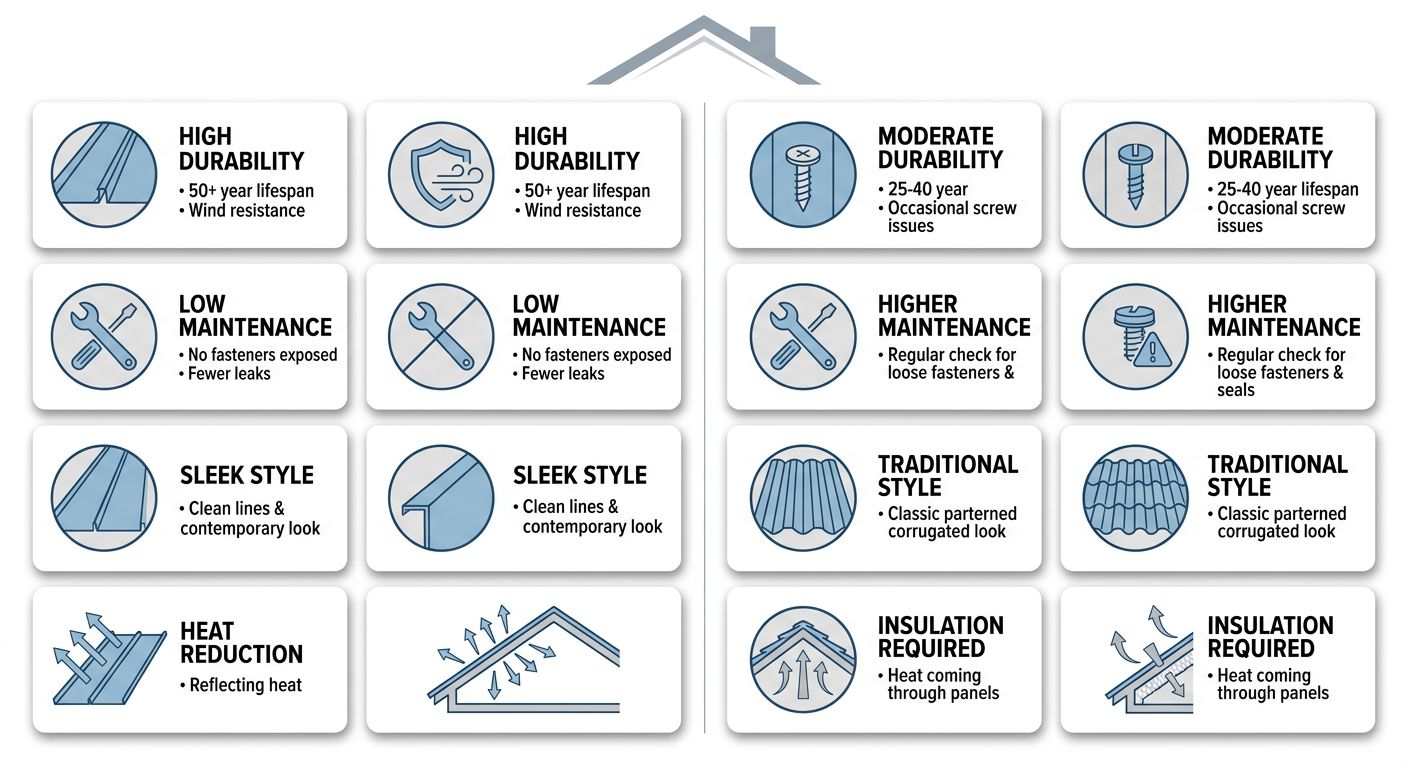
Quick comparison of standing seam vs exposed fastener metal roofing for Vancouver homeowners.
In Vancouver’s wet coastal climate, the concealed fastener design of a standing seam system offers enhanced weathertightness by reducing potential entry points for moisture. Exposed fastener systems, while economical, require diligent maintenance to keep gaskets and screws secure against our region’s heavy rainfall.
For a deeper look at how standing seam compares to metal shingles in Vancouver, see our blog on standing seam vs metal shingles in Vancouver. Beyond these two systems, other metal styles and alternative materials such as asphalt or tile will be explored in the following sections.
Paragon Roofing BC: Standing Seam Installation and Service
When you choose standing seam metal roofing, you are investing in a premium, long-lasting system, and our team at Paragon Roofing BC delivers expert installation across the Lower Mainland. We specialize in residential, commercial, and multi-family projects, ensuring you get a precise fit and a clean, modern look. While we offer competitive rates, we understand that standing seam metal roofing costs are a key consideration, and we help you navigate options that align with your budget and long-term goals.
As a metal roofing services in Vancouver provider with decades of local experience, our BBB A+ accreditation reflects our commitment to quality. We back our work with manufacturer-backed warranties, giving you confidence that your new roof is built to endure coastal humidity, high winds, and heavy rainfall.
Our standing seam services cover everything from new installations and full roof replacements to repairs and proactive maintenance. Standing seam vs exposed fastener systems is a common discussion, and we guide you toward the hidden-fastener option for superior weather resistance and a sleek appearance that eliminates exposed screws. Over time, the enhanced durability of a standing seam roof can contribute to strong metal roofing resale value, a point many homeowners appreciate when planning for the future.
We proudly serve as a Trusted Roofing Contractor Across British Columbia, from Vancouver and Surrey to Richmond, Burnaby, Coquitlam, and Whistler. Every project begins with a free on-site inspection and photo report, giving you a clear picture of your roof’s condition before we recommend a path forward.
Protecting Your Home. Building Your Family’s Future. We invite you to book your free inspection today, and let us show you why Paragon Roofing BC is the name homeowners, strata councils, and commercial property managers rely on. Warranties vary by manufacturer, and our team will review all details with you before work begins.
Coastal Climate and Durability for Standing Seam Roofs
For property owners evaluating standing seam metal roofing costs, the initial investment is best understood through the lens of durability, particularly in the challenging coastal environments of British Columbia. In regions like Metro Vancouver and the Lower Mainland, roofing systems face a relentless combination of salt-laden air, persistent moisture, strong wind uplift, and high UV exposure. These elements accelerate the degradation of traditional materials, but a properly specified standing seam metal roof offers proven resilience. The concealed fastener design is central to this longevity, eliminating the thousands of exposed penetration points found in standard panel systems. When assessing standing seam vs exposed fastener, the difference is critical for coastal installations, where each exposed screw represents a potential entry point for moisture and a site for corrosive wear.
At Paragon Roofing BC, we have seen how high-quality metal roofing systems withstand our local climate. Modern standing seam profiles feature Galvalume or advanced aluminum-zinc alloy coatings, factory-applied to the steel substrate for exceptional cut-edge protection. This is then fortified with highly durable Kynar 500 or Hylar 5000 paint systems, forming a barrier against salt spray oxidation. The metal roofing alliance guide details these material advancements, confirming why properly coated systems are so effective in seaside applications. Beyond weather barriers, the cool-roof properties of these finishes can significantly reduce cooling costs by reflecting solar radiant heat, a welcome benefit during the increasingly warm summers on Vancouver Island. With a typical service life of 40 to 70 years, the reduced frequency of replacement cycles compared to asphalt directly contributes to strong metal roofing resale value and long-term peace of mind.
Warranties vary by manufacturer and product — check manufacturer terms and written contract. In the next section, we break down the cost factors that make standing seam a smart long-term investment.
Your Guide to Getting a Standing Seam Metal Roof in Vancouver
Understanding standing seam metal roofing costs begins with recognizing the system’s unique design. These roofs feature vertical interlocking panels with hidden fasteners, a sleek modern look that has become popular for Vancouver homeowners. According to the metal architecture publication, industry standards for these panels prioritize weathertight performance, a critical factor in our rainy coastal climate. The final cost depends on several variables including material gauge, roof complexity, labour and local climate considerations.
One major decision you will face is standing seam vs exposed fastener roofing. Exposed fastener systems are initially more affordable, but they rely on thousands of screws with rubber gaskets that can degrade over time. Standing seam panels conceal all fasteners beneath the raised seam, virtually eliminating the risk of leaks from fastener failure and delivering superior long-term durability. This makes them a sound investment for your home.
Metal roofing resale value is another important benefit to weigh. A professionally installed standing seam roof can increase your property’s appeal thanks to its exceptional longevity and potential for energy savings. As your trusted roofing contractor across British Columbia, we draw on decades of local Lower Mainland experience to guide your decision. We offer free on-site inspections and a detailed quote tailored to your home. Warranties vary by manufacturer and product, so we encourage you to check the written contract for full terms and conditions.
Long-Term Value of Standing Seam Metal Roofing
Standing seam metal roofing is a lasting investment, with proper installation by our team, these roofs typically last 40 to 70 years thanks to their concealed fastener system that resists leaks and demands minimal upkeep. Reflective coatings help reduce summer cooling costs, and the material’s 100% recyclability adds environmental value. According to national roofing contractors association resources, standing seam systems outlast exposed-fastener alternatives by eliminating fastener failure points. Industry studies also link metal roofing to a 1% to 6% boost in resale value. We see hidden-fastener metal roofs thriving in BC’s coastal climate, rewarding homeowners with decades of peace of mind.
Resources
- Discover Metal Roof Costs and Energy Rebates in Vancouver
- Get Expert Metal Roofing Installation and Repair in Vancouver
- Compare Standing Seam vs Metal Shingles in Vancouver
- Discover New Roofing Materials for Pacific Northwest
- Explore 2026 Roofing Material Trends for BC Homeowners
- Learn About TPO and Torch-On Roofing for BC Climate
- Compare Metal, TPO, Shingle, and Slate Roofing in Vancouver
- Explore Metal Roofing Alliance Resources for Homeowners
- Discover Metal Architecture Industry Guides and Awards
- Get NRCA Roofing Certifications and Business Resources
Table of Contents
- Roof Repair in Vancouver: What Homeowners Need to Know
- Understanding Roof Issues in Vancouver’s Climate
- Common Roof Repair Services for Vancouver Homes
- How Vancouver’s Weather Affects Roof Longevity
- Steps to Address Roof Damage in Vancouver
- Protecting Your Home with Timely Roof Repairs
Roof Repair in Vancouver: What Homeowners Need to Know
When it comes to roof repair in Vancouver, our wet climate causes distinct challenges like leaks, moss, and shingle damage. Starting with a professional roof inspection can reveal hidden issues before they lead to costly structural damage and mold.
Common Roof Repair Issues in Vancouver
Our local weather often leads to roof leaks, missing or curled shingles, heavy moss growth, and damaged flashing. These problems can compromise your home’s protection and require prompt attention.
Signs You Need Roof Repairs
Watch for water stains on ceilings, granules in gutters, or daylight coming through the roof boards. Timely repairs extend your roof’s lifespan and are often more cost-effective than a full replacement.
As a licensed, BBB A+ rated contractor with decades of local experience, Paragon Roofing BC offers free on-site inspections with photo reports and strictly follows WorkSafeBC safety protocols.
Understanding Roof Issues in Vancouver’s Climate
Vancouver’s coastal climate creates unique challenges for residential roofing. Homeowners frequently need roof repair Vancouver services due to persistent moisture and environmental factors. Heavy rainfall, high humidity, salt air near the waterfront, and abundant tree debris all contribute to accelerated wear on roofing systems across the Lower Mainland.
We at Paragon Roofing BC have seen how these conditions affect different neighborhoods in distinct ways. The following table outlines common issues by area and the recommended actions to protect your home.
| Area | Climate Exposure | Common Roof Issues | Recommended Action |
|---|---|---|---|
| Downtown Vancouver | High rainfall, wind, and salt air | Leaks around vents, flashing failure, moss growth | Bi-annual inspections, prompt leak repair |
| West Side | Heavy rain, tree debris | Clogged gutters, shingle granule loss, leaks | Gutter cleaning, shingle replacement as needed |
| East Vancouver | Variable rainfall, older homes | Aged roofing materials, flashing deterioration | Full inspection, consider replacement if age >20 years |
Understanding these regional differences helps homeowners recognize early warning signs before minor problems escalate. The National Roofing Contractors Association recommends bi-annual inspections in high-moisture zones to catch seasonal damage early. For those needing roofing services in South Surrey, our team brings over two decades of local experience to every project.
Vancouver roof problems vary by neighborhood, but proactive roof maintenance Vancouver strategies make a significant difference. The next section explores practical inspection and repair services that keep your roof in peak condition year-round.
Common Roof Repair Services for Vancouver Homes
When heavy rain or coastal winds expose vulnerabilities, timely roof repair Vancouver homeowners trust becomes essential to prevent small issues from escalating. Our team at Paragon Roofing BC begins every job with a free on-site inspection and photo report, so you understand exactly what your roof needs before any work starts.
The most frequent residential repairs we handle include:
- Leak detection and repair – caused by damaged shingles, deteriorated flashing, or clogged gutters. We trace moisture entry and seal it at the source.
- Shingle replacement – matching your existing materials and securing weatherproof layers that stand up to BC’s wet climate.
- Flashing repair – resealing vulnerable points around chimneys, vents, and skylights to stop water intrusion.
- Gutter and downspout cleaning or repair – restoring proper drainage so runoff doesn’t back up under the roof edge.
- Ventilation and roof-vent repair – correcting airflow to prevent moisture buildup and ice dams that shorten roof life.
Each residential roof repair Vancouver service follows a diagnostic-first approach, and our technicians apply the same rigorous standards we use on larger projects. In addition to our residential services, we also provide commercial roof repair in Vancouver for business properties. Protecting Your Home. Building Your Family’s Future. — that’s the commitment behind every repair we complete.
Now that you know the common repairs, learn how our technicians carry out each service.
How Vancouver’s Weather Affects Roof Longevity
For homeowners looking into roof repair Vancouver, the local climate is the single most important factor dictating how long their roofing system will last. According to the British Columbia provincial government portal, the Lower Mainland experiences over 160 rainy days annually, creating persistent moisture that fuels moss growth, wood rot, and the gradual erosion of protective granules on asphalt shingles. Without consistent attention, this moisture exposure can cut a roof’s expected lifespan by several years.
Beyond the rain, clear summer skies bring strong UV radiation that breaks down roofing materials over time, causing fading, cracking, and embrittlement in both asphalt and cedar shakes. Winter introduces a damaging freeze-thaw cycle, where water seeps into tiny cracks, freezes and expands, then thaws—widening fissures and creating pathways for leaks. Poor attic ventilation and clogged gutters compound these effects, trapping moisture against the roof deck and accelerating structural wear regardless of the material chosen.
Choosing weather-resistant options like metal or high-grade asphalt can noticeably extend service life in Vancouver’s demanding conditions. At Paragon Roofing BC, our decades of local experience have shown that routine maintenance—twice-yearly inspections, gutter cleaning, and timely moss treatment—is the most effective defence against this climate. Protecting Your Home. Building Your Family’s Future. Understanding these regional weather challenges makes it clear why proactive care from a trusted, BBB A+ accredited contractor is essential for preserving your roof’s integrity.
Steps to Address Roof Damage in Vancouver
Discovering damage to your roof can be stressful, making timely roof repair in Vancouver essential to prevent further water intrusion. Following a clear, safety-first process helps you protect your property while avoiding unnecessary risks.
- Assess damage from the ground first. Never climb onto a damaged roof without proper fall protection and training. Look for missing shingles, sagging areas, or debris from a safe vantage point.
- Document everything you see. Take clear photos and write detailed notes about the damage. This creates a valuable record for your insurance provider and any contractor you consult.
- Contact a professional roofing contractor. We recommend reaching out immediately for a comprehensive inspection and repair estimate. Professional evaluation identifies hidden structural issues that ground-level observation cannot reveal.
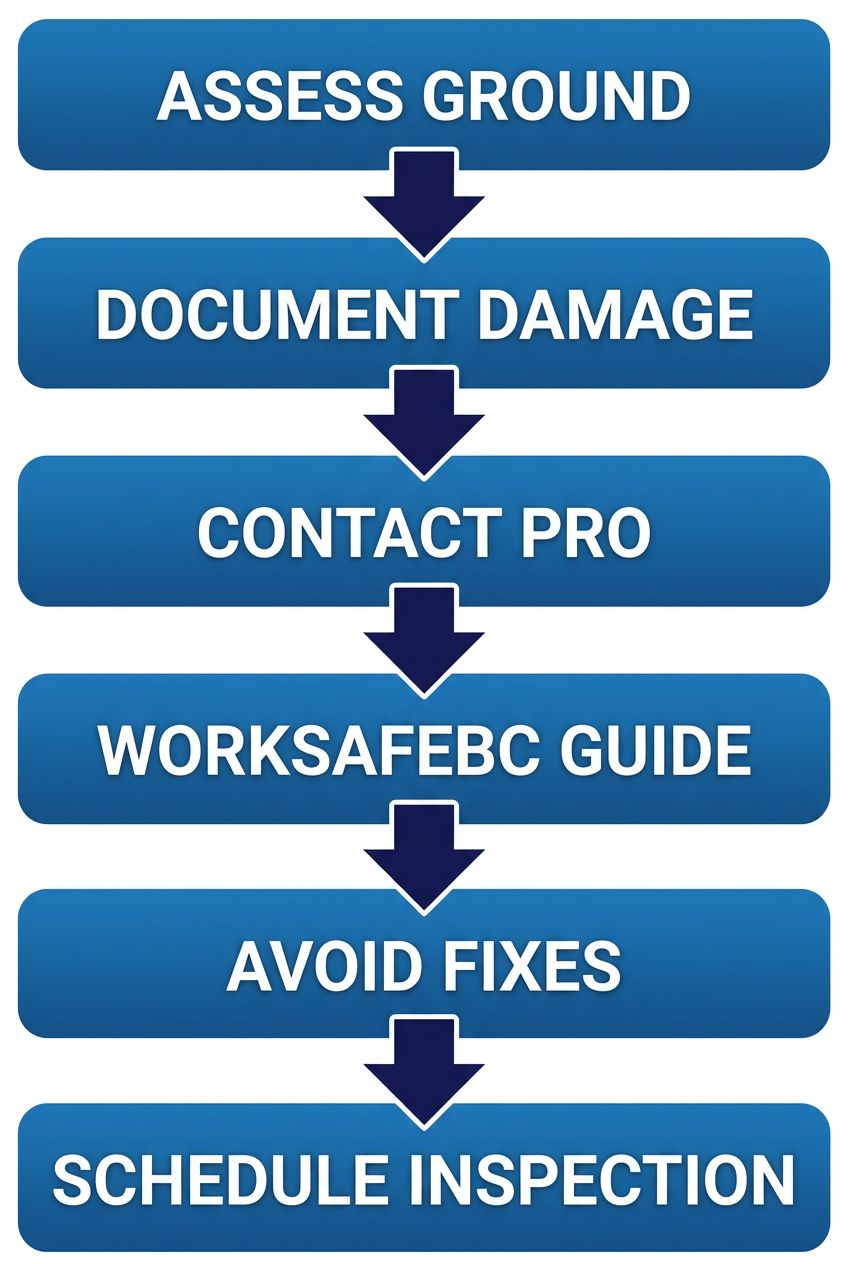
Six-step roof damage response process for Vancouver homeowners from Paragon Roofing BC.
Before anyone accesses your roof, review WorkSafeBC roof safety guidelines, which set the regulatory standard for fall protection and safe work practices in British Columbia. Avoid temporary fixes that may worsen the damage or create hazards — emergency tarping and repairs should always be left to qualified professionals who carry proper insurance and WorkSafeBC coverage.
Schedule your inspection promptly. Delaying repairs often leads to escalating water damage and costly structural deterioration. We encourage you to take the next step by booking a free on-site inspection with us, the Trusted Roofing Contractor Across British Columbia, so you can move forward with confidence and clarity.
Protecting Your Home with Timely Roof Repairs
When you need roof repair in Vancouver, acting quickly is one of the most important steps you can take toward Protecting Your Home. A small leak or loose shingle may seem minor, but coastal weather can turn it into widespread water damage in weeks. We follow best practices endorsed by the roofing industry association to catch these problems early.
Delaying work lets moisture reach sheathing, framing, and drywall, which threatens your family’s safety and raises repair costs. Timely roof repairs help protect interiors, preserve foundation integrity, and keep your home secure during British Columbia’s rainy seasons.
We offer a free on-site inspection that makes it easy to identify trouble before it grows. Prompt roof repair extends your roof’s lifespan and saves you money long-term, and that commitment to proactive care is what drives our work across the Lower Mainland.
Resources
- Get Expert Roofing Services in South Surrey
- Get Expert Commercial Roof Repair in Vancouver
- Get Professional Roof Inspection in Lower Mainland
- Get Emergency Roof Leak Repair in Vancouver
- Discover Warning Signs for Roof Inspection
- Get Expert Commercial Roof Inspection in Vancouver
- Discover Roof Inspection Pricing for Your Property
- Explore NRCA Resources for Roofing Professionals
- Access BC Government Services and Resources
- Explore WorkSafeBC Resources for Workplace Safety
Table of Contents
Comparing TPO and EPDM Flat Roofing in Vancouver, British Columbia
When considering a flat roof TPO vs EPDM, these two single-ply membranes dominate the lower mainland market. As a Trusted Roofing Contractor Across British Columbia, we often guide property owners through this choice. Our experience with TPO roofing and rubber systems helps clarify the TPO vs EPDM comparison for Vancouver’s unique climate.
Regarding TPO vs EPDM lifespan, the National Roofing Contractors Association benchmarks TPO at 20–30 years, whereas EPDM typically reaches 25–30 years. The TPO vs EPDM cost per square foot is competitive for both, though TPO often has a lower upfront investment. Unlike EPDM’s flexible rubber, TPO’s heat-welded seams and reflective surface deliver energy savings during warmer months.
For a building owner deciding on TPO or EPDM for flat roofs, Vancouver’s wet conditions and UV exposure are key factors. EPDM resists ponding water exceptionally well, while TPO’s reflectivity reduces the heat island effect. We recommend a free inspection to assess your specific roof and provide warranty-backed guidance.
1. Climate Resilience for Vancouver Winters
When evaluating a flat roof TPO vs EPDM, Vancouver’s unique winter climate becomes a critical factor. Our region endures relentless heavy rainfall, sharp freeze-thaw cycles, and surprising UV exposure that can compromise lesser roofing systems. According to the National Roofing Contractors Association standards, selecting the right single-ply membrane is a foundational decision for long-term performance. We see TPO as a compelling option with its reflective surface that actively combats UV degradation and helps mitigate urban heat island effects. In contrast, EPDM is a rubber membrane prized for its exceptional elasticity, remaining flexible even during deep freezes that would embrittle other materials. Both membranes, when installed and maintained correctly, can provide robust weather resistance, but the ideal comparison of TPO and EPDM membranes hinges on your specific roof’s architecture and exposure. Understanding their general characteristics here sets the stage for a deeper look into TPO vs EPDM lifespan and cost.
2. Energy Efficiency and Reflective Performance
Choosing between a flat roof TPO vs EPDM system often begins with understanding how each membrane handles energy. Cool roofing is a design strategy that uses reflective surfaces to reduce heat absorption, which is particularly valuable for low-slope applications where the sun beats down directly throughout the day. In Vancouver’s variable climate, selecting the right material can help lower indoor temperatures during warmer months and reduce strain on cooling equipment.
TPO membranes are typically bright white and carry high Solar Reflectance Index (SRI) values, with many products earning ENERGY STAR qualification for their ability to reflect a significant portion of solar radiation. This reflective property means the building retains less heat, which directly translates into lower peak cooling demand. EPDM, by contrast, is a dark rubber membrane that historically absorbs more heat, though newer formulations now include reflective coatings that improve performance and narrow the efficiency gap between the two materials.
The real-world benefit of a reflective flat roof system is consistent: when the sun hits a membrane that bounces rather than absorbs energy, utility bills trend downward. Paragon Roofing BC has observed that clients who opt for high-reflectance membranes frequently report more stable upper-floor temperatures and less reliance on air conditioning during British Columbia’s summer stretches. This is not just about immediate comfort—it’s about long-term operational savings for any building type.
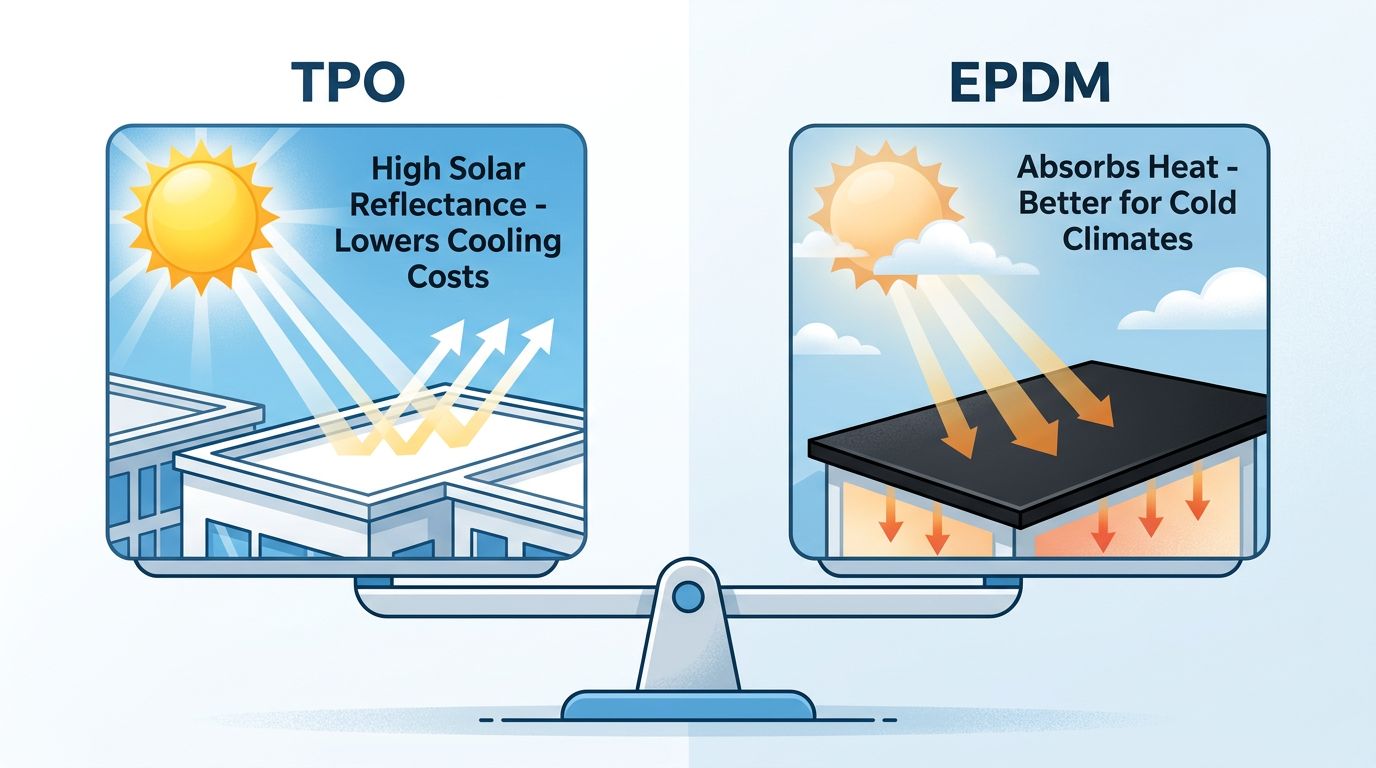
Beyond the membrane colour and reflectivity, building use and climate zone heavily influence the right choice. Reflective roofing delivers the most dramatic savings in warm climates, yet even in the Lower Mainland, a high-SRI TPO surface can reduce rooftop temperatures enough to extend the life of underlying components. Unlike dark asphalt shingles, which absorb heat and transfer it into the structure, reflective TPO membranes help keep buildings cooler—an advantage that matters whether you manage a commercial property or a multi-family strata. Roofing. It’s what we do.
While energy efficiency heavily influences material choice, upfront costs also play a key role, which we explore next.
3. Long-Term Lifespan and Durability
When evaluating flat roof TPO vs EPDM, lifespan often drives the decision. Both materials typically last 20 to 30 years with proper installation. TPO membranes use heat-welded seams, while EPDM employs adhesive-bonded seams — a detail that affects long-term reliability.
Durability factors include UV resistance, puncture resistance, and thermal expansion. TPO’s reflective surface handles UV exposure well, whereas EPDM’s dark color can absorb heat but demands careful seam maintenance in temperature swings. While these membranes serve flat roofs, asphalt shingles — which also last 20 to 30 years — are designed for sloped roofs, underscoring that material selection must match roof design.
In the TPO vs EPDM lifespan comparison, both perform comparably when installed and maintained correctly. With extensive experience installing TPO and EPDM systems throughout the Lower Mainland, we know that professional workmanship and annual inspections heavily influence how long a flat roof membrane will serve your home.
4. Installation Process and Complexity
When evaluating flat roof tpo vs epdm, installation complexity often becomes a deciding factor. At Paragon Roofing BC, we draw on decades of general roofing experience—including principles of proper underlayment and deck preparation—to ensure every low-slope system in Vancouver is installed to last.
A typical flat roofing membrane installation follows a clear sequence: deck preparation and cleaning, rigid insulation placement, membrane layout with adequate overlaps, seaming, and finally flashing penetrations and edges. Both systems demand correct roof slope and drainage to prevent ponding water.
TPO vs EPDM installation differs significantly at the seaming stage. TPO requires hot-air welding using specialized equipment and trained operators. The melted seams create a monolithic, watertight bond. EPDM relies on adhesive seaming where liquid adhesive or tape is applied, followed by seam-priming and rolling in careful curing conditions. EPDM can be ballasted, mechanically attached or fully adhered, while TPO is usually mechanically attached or fully adhered.
| Feature | TPO Membrane | EPDM Membrane |
|---|---|---|
| Seaming Method | Hot-Air Heat Welding | Adhesive Tape/Liquid Bond |
| Primary Colour | White (High Reflectivity) | Black (Heat Absorbent) |
| Chemical Resistance | High Resilience | Moderate |
Regardless of the membrane chosen, installing flat roofs in BC’s climate demands attention to weather windows and safety protocols—lessons we carry forward from every project. By weighing the hot-air welding demands of TPO against the careful adhesive-cure schedule of EPDM, building owners can align complexity with their contractor’s expertise.
5. Repair and Maintenance Simplicity
When comparing flat roof TPO vs EPDM, repair and ongoing maintenance simplicity weighs heavily in the total cost of ownership. We find that the heat-welded seams of TPO require professional hot-air tools for repairs, yet they create a monolithic, seamless patch that is highly durable. In contrast, EPDM repairs often rely on liquid adhesives or peel-and-stick patches, which may be more DIY-friendly but can leave seams that are less resistant to the Lower Mainland’s wet, windy conditions.
Both systems benefit from regular inspections, particularly around flashings, drains, and gutters. Drawing on our internal expertise, we recommend that homeowners schedule a professional roof check at least twice a year and after major storms. Simple tasks like clearing leaves from drains and preventing snow buildup apply equally to TPO and EPDM, and they significantly extend TPO vs EPDM lifespan in British Columbia.
When we discuss TPO compared to EPDM with our clients, we note that TPO typically comes with longer manufacturer warranties, though we always remind homeowners that warranties vary by manufacturer and product — check manufacturer terms and your written contract. Overall, the ease of maintenance and the reliability of repairs influence how practical each material feels over the years, which is something we explore further in our discussion of installation and cost considerations.
6. Cost Per Square Foot in British Columbia
When evaluating flat roof TPO vs EPDM, understanding the cost per square foot is essential for budgeting your project in British Columbia. As a trusted roofing contractor across British Columbia, we provide transparent pricing guidance based on our extensive experience across the Lower Mainland.
In British Columbia, TPO roofing typically ranges from $2.50 to $4.50 per square foot installed, while EPDM installation costs generally fall between $2.00 and $3.50 per square foot. These TPO vs EPDM cost per square foot estimates include materials and labour, though final pricing depends on several project-specific factors.
Key elements that influence your total investment include:
- Roof size and complexity of the layout
- Accessibility for crew and equipment
- Whether existing roofing materials require removal
- Membrane thickness and manufacturer warranty selection
- Your specific location within British Columbia
We offer free on-site inspections and detailed quotes so you receive an accurate price tailored to your property. Estimates and final prices are subject to on-site inspection and final scope confirmation. Understanding the cost lets you weigh initial investment against long-term value before we discuss the installation process in the next section.
7. Modern Architectural Versatility
When weighing flat roof TPO vs EPDM for your project, architectural versatility stands out as a decisive factor. We see modern design trends in British Columbia increasingly favour clean, low-profile lines that both of these membranes deliver. TPO and EPDM systems let you achieve a sleek, unobtrusive roof plane that complements contemporary homes and commercial buildings without visual clutter.
Beyond appearance, these flat roofing options readily accommodate functional rooftop features — skylights, solar panels, or green roofs — while maintaining a cohesive look. Asphalt shingles also contribute to this flexibility, offering a wide range of colours and styles, as our FAQ page illustrates. Whether you want the crisp membrane aesthetic or shingle texture, all three materials meet high aesthetic and performance standards.
Considering the tpo vs epdm lifespan and tpo vs epdm cost per square foot further confirms their value; the right choice balances enduring performance with design freedom. Next, we compare TPO and EPDM directly to help you understand exactly how these factors affect your investment.
8. Warranty Coverage and Manufacturer Support
When considering flat roof tpo vs epdm, warranty coverage is a decisive factor. TPO manufacturer warranties typically offer 15 to 30 years of material defect protection, reflecting a strong tpo vs epdm lifespan advantage. At Paragon Roofing BC, we complement this with a workmanship warranty backed by liability insurance and WorkSafeBC coverage.
EPDM warranties cover membranes for up to 20 years. While the tpo vs epdm cost per square foot may be lower for EPDM, shorter coverage could influence total ownership value. Reviewing manufacturer details is essential as terms and transferability vary.
Key differences between the two systems include:
- TPO warranties: 15–30 years, transferable depending on manufacturer, tied to membrane thickness.
- EPDM warranties: up to 20 years, transferability varies, exclusions for improper installation common.
- Manufacturer warranties cover material defects only; our workmanship warranty covers installation quality.
We encourage a free, no-obligation inspection and photo report before warranty work begins. Please confirm exact terms in your written contract and manufacturer documentation. Warranties vary by manufacturer and product — check manufacturer terms and written contract. When you select Paragon Roofing BC, you secure manufacturer-backed warranties plus our local expertise. Protecting Your Home. Building Your Family’s Future.
Choosing Between TPO and EPDM for Your Flat Roof
When comparing flat roof tpo vs epdm, we look at two of the most popular single-ply membrane systems for low-slope applications across British Columbia. Paragon Roofing BC installs both, and the right choice depends on your building’s specific needs.
The tpo vs epdm lifespan comparison shows EPDM typically lasting 20 to 25 years, while TPO generally offers 15 to 20 years with proper maintenance. For tpo vs epdm cost per square foot, EPDM material costs tend to be slightly lower, though TPO’s heat-weldable seams and superior energy efficiency often reduce long-term cooling expenses. In the Lower Mainland’s variable climate, EPDM’s proven flexibility and resistance to thermal shock make it a durable choice, while TPO’s reflective white surface excels at lowering interior temperatures.
We recommend a professional on-site inspection to evaluate your roof’s structure, exposure, and drainage before deciding. Our free inspection and photo report gives you clear data for an informed decision.
Resources
- Get Asphalt Shingles for BC Rainy Climate Conditions
- Common TPO Roofing Problems in BC’s Lower Mainland
- Learn How to Maximize Asphalt Shingle Lifespan in Vancouver
- Get Top Asphalt Shingle Color Trends and Warranty Tips
- Get the Complete Guide to Asphalt Shingles in Vancouver
- Learn How TPO Roofing Reduces Cooling Costs in BC
- Learn TPO Roofing Costs, Benefits, and Warranty Info
- Discover NRCA Training, Advocacy, and Mental Health Resources
Table of Contents
- Commercial Roofing in Delta, British Columbia
- Delta’s Commercial Roofing Landscape
- Commercial Roofing Services Available in Delta
- Local Factors Influencing Commercial Roofs in Delta
- Initiating Commercial Roofing Projects in Delta
- Advancing Your Delta Commercial Roofing Needs
Commercial Roofing in Delta, British Columbia
In Delta, British Columbia, commercial roofing delta demands durability against the region’s wet coastal climate, marked by heavy rainfall and strong winds. These conditions challenge commercial properties, making robust roofing essential to protect assets and operations, while protecting occupants.
As Paragon Roofing BC, we deliver trusted delta roofing services (delta roofing services) tailored for local needs. Our offerings include expert commercial roof repair delta bc and specialized commercial flat roofing delta, utilizing torch-on, TPO, and EPDM systems as per Roofing Contractors Association of British Columbia (RCABC) guidelines for quality and compliance.
Professional installation by our team prevents leaks, extends roof lifespan, and ensures long-term value. Discover our full range of solutions next.
Delta’s Commercial Roofing Landscape
In Delta’s unique climate, the commercial roofing delta landscape demands resilient materials to withstand heavy rainfall exceeding 1,200 mm annually and frequent wind gusts up to 60 km/h, as noted in practical local insights from Paragon Roofing BC. Mild temperatures amplify needs for waterproofing and UV resistance on commercial structures like warehouses and offices. We at Paragon Roofing BC specialize in Delta BC commercial roofing services tailored to these challenges.
Commercial buildings in Delta often feature low-slope and flat roofs vulnerable to ponding water, UV degradation, and wind uplift. Commercial flat roofing delta solutions must prioritize multi-layer protection and durability to prevent leaks and extend service life.
Commercial Roofing Material Comparison for Delta
This table compares popular commercial roofing materials suitable for Delta’s climate, focusing on durability, cost, and suitability for local weather conditions like heavy rain and wind.
| Material | Durability (Years) | Cost per sq ft | Best for Delta Climate |
|---|---|---|---|
| TPO | 20-30 | $8-12 | Excellent for flat roofs, UV and puncture resistant |
| Torch-On Modified Bitumen | 15-25 | $7-11 | Multi-layer waterproofing ideal for low-slope roofs |
| Metal Roofing | 40+ | $10-16 | Long-lasting, wind-resistant for commercial structures |
TPO offers cost-effective performance for commercial flat roofing delta, while Metal Roofing excels in windy conditions with superior longevity. Following RCABC roofing in British Columbia guidelines ensures compliance, as current industry technical guidelines from the Roofing Contractors Association of BC (RCABC) emphasize wind-resistant standards.
Key takeaways include biannual inspections for moss and debris—moss treatment can extend roof life by 3-5 years per Paragon Roofing BC. Prompt commercial roof repair delta bc prevents escalation from seasonal storms. These practices align with authoritative provincial association standards from RCABC.
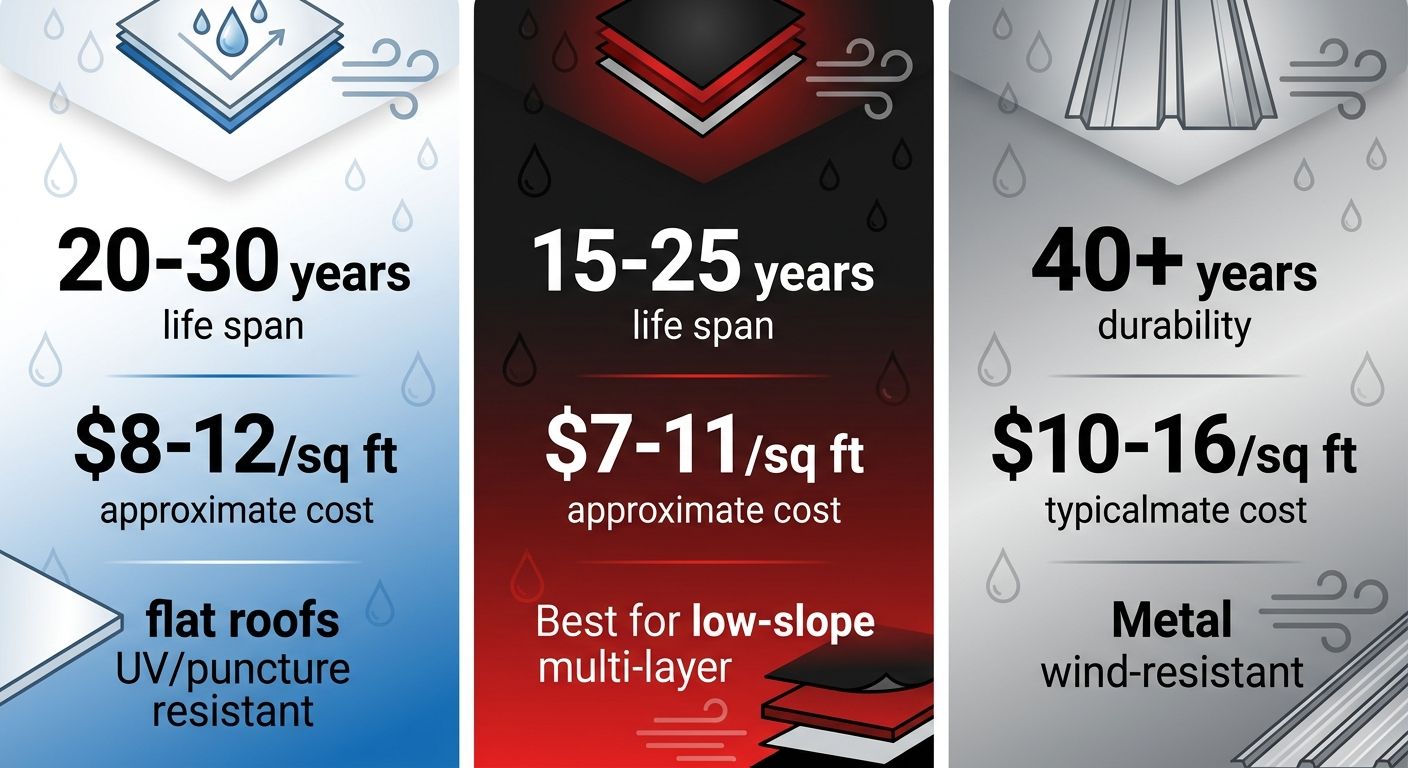
Key commercial roofing materials comparison for Delta’s climate
For expert installation or commercial roof repair delta bc, contact Paragon Roofing BC—we deliver RCABC-aligned solutions for your Delta projects.
Commercial Roofing Services Available in Delta
In Delta, BC, Paragon Roofing BC provides comprehensive commercial roofing delta services tailored to local businesses and industrial properties. We specialize in solutions that withstand the region’s wet coastal climate, heavy rainfall, and UV exposure, drawing from our decades of experience across the Lower Mainland.
- Commercial roof repair in Delta, BC: We handle prompt commercial roof repair delta bc for leaks, damage, and wear, using durable materials to prevent water pooling common in Delta’s conditions, as per Paragon Roofing BC’s official offerings.
- Commercial flat roofing installations: Offering commercial flat roofing delta with torch-on, EPDM, TPO, PVC, and modified bitumen systems designed for waterproofing and longevity on low-slope roofs.
- Roof inspections: Free onsite assessments adapted from Paragon Roofing BC’s practical guidelines, including leak detection, flashing checks, and material evaluations to identify issues like moisture damage early.
- Maintenance programs: Ongoing care to extend roof life, aligned with RCABC technical updates for compliance and NRICA industry training benchmarks on safety protocols and material selection.
- Emergency repairs: Rapid response for storm damage or urgent failures, ensuring minimal downtime for Delta commercial operations.
These Delta commercial roofing options protect your investment while meeting high standards. Contact us today for a free inspection or quote on your next project and explore details on costs and timelines.
Local Factors Influencing Commercial Roofs in Delta
In Delta, general commercial roofing challenges are amplified by unique local weather patterns, stringent safety regulations, and evolving industry standards. We see these factors shape commercial roofing delta practices daily, demanding proactive strategies from property owners.
Delta’s heavy rainfall—averaging 8.8 inches in November—coastal winds from Boundary Bay, and mild winters with high humidity foster moss growth and debris buildup. Paragon Roofing BC’s practical local roofing company maintenance guidance recommends seasonal tasks such as:
- Fall: Clear leaves and debris from flat roofs to prevent clogs.
- Spring: Inspect and treat moss, which can hold four times its weight in water.
These steps safeguard commercial flat roofing delta against accelerated wear.
Fire and explosion hazards from asphalt handling pose significant risks in commercial roofing delta. WorkSafeBC’s official workplace safety guidelines on asphalt plant fire risks highlight how heated asphalt releases flammable vapors, urging ventilation, housekeeping, and equipment checks to mitigate ignition sources like dust accumulation. Meanwhile, Roofing Contractors Association of BC (RCABC) authoritative provincial bulletins update membrane installation and wind uplift resistance standards suited to coastal conditions.
Addressing these local factors requires expert commercial roof repair delta bc.
Initiating Commercial Roofing Projects in Delta
Once you’ve identified roofing needs from prior assessments, initiating commercial roofing delta projects ensures efficiency and compliance. We guide commercial property owners through essential steps tailored to Delta’s wet climate and regulations.
Start with a roof inspection using Paragon Roofing BC’s practical checklist for initial evaluations, adapted for commercial buildings. Check for leaks, flat roof integrity, and structural issues common in Delta BC. Next, schedule a free consultation with us for thorough commercial roof repair delta bc assessments. Obtain permits from Delta municipal authorities, especially for commercial flat roofing delta emphasizing energy-efficient options. Incorporate eco-friendly materials early, as Paragon Roofing BC recommends for sustainable integrations. Ensure timelines, warranties, and maintenance plans are discussed before work begins, with clear documentation and scheduled follow-ups.
Proper initiation preserves delta roofing home value through quality services, per our internal expertise as a leading Delta provider. Contact Paragon Roofing BC today for personalized Delta commercial roofing projects. With assessment complete, explore material options next.
Advancing Your Delta Commercial Roofing Needs
Building on our comprehensive services, Paragon Roofing BC leads commercial roofing in Delta with decades of reliable innovation. As our primary service portfolio outlines, we integrate eco-friendly roofing in Delta solutions tailored for commercial properties, per expert blog insights on sustainable practices.
Need commercial roof repair in Delta BC or commercial flat roofing in Delta? Contact us today for quick responses and superior results that safeguard your business.
This article was researched and written with the assistance of AI tools.
Resources
- Get Certified Delta Roofing Services with Free Inspections
- Explore Eco-Friendly Roofing Options for Delta Homes
- Learn How Quality Roofing Boosts Delta Home Value
- Follow Delta Seasonal Roof Maintenance Checklist Guide
- Use Essential Roof Inspection Checklist for Delta Buyers
- Get Comprehensive South Surrey Roofing Services Today
- Get 24/7 Emergency Roof Leak Repair Services
- Discover RCABC Technical Updates and Roofing Standards
- Explore RCABC Roofing Guarantees and Training Programs
- Reduce Fire Risks in Asphalt Plants Effectively
- Find Commercial Roofing Training and Certification Guide
Table of Contents
- Exploring TPO Roofing in British Columbia
- What is TPO Roofing?
- Key Benefits of TPO Roofing for BC Properties
- How TPO Roofing Systems Function
- Best Practices for TPO Roofing Maintenance and Installation
- Maximizing TPO Roofing Performance in British Columbia
Exploring TPO Roofing in British Columbia
In the diverse climate of British Columbia, where heavy rains and coastal winds challenge building structures, TPO roofing in British Columbia emerges as a reliable solution for flat and low-slope roofs. Thermoplastic polyolefin, or TPO, is a single-ply flat roofing solution known for its durability and energy efficiency. As a thermoplastic membrane system, it forms a seamless, waterproof barrier that withstands UV exposure and temperature fluctuations common in regions like Vancouver, BC.
At Paragon Roofing BC, we bring decades of local experience as a trusted roofing contractor across British Columbia. Specializing in roofing materials services in Vancouver, we handle installations and maintenance for residential, commercial, and multi-family properties throughout the Lower Mainland. Our team offers free on-site inspections to assess your needs, ensuring TPO systems that resist moss growth and leaks while optimizing energy savings. When considering TPO vs PVC roofing, TPO stands out for its cost-effectiveness, with TPO roofing cost often providing better long-term value through reflectivity that reduces cooling demands.
This guide explores the fundamentals of TPO, its key benefits for BC’s weather, how these systems function, and best practices for installation and upkeep. From Vancouver’s flat-roof commercial buildings to Surrey homes, discover why TPO is ideal. What makes TPO roofing perform so effectively in our variable conditions?
What is TPO Roofing?
TPO roofing in British Columbia has become a go-to solution for protecting properties against the region’s persistent rainfall and variable temperatures. As a thermoplastic polyolefin membrane, TPO offers durability and energy efficiency, making it ideal for flat and low-slope roofs common in the Lower Mainland. We at Paragon Roofing BC have installed countless TPO systems, witnessing their resilience firsthand in areas like Coquitlam and Vancouver.
Definition: TPO Roofing
Thermoplastic Polyolefin (TPO) is a single-ply roofing membrane made from a blend of polypropylene and ethylene-propylene rubber, providing waterproofing and reflectivity for modern structures.
Composition and Materials
TPO membranes consist of advanced polymer blends designed for longevity in demanding climates. The core material combines polypropylene for strength with ethylene-propylene for flexibility, enhanced by UV stabilizers to resist sun damage prevalent in British Columbia’s coastal areas. A fleece backing adds reinforcement, preventing punctures from debris or foot traffic during maintenance. We recommend layers including a weather-resistant top coat and scrim reinforcement for added tear resistance.
- Top Layer: UV-stabilized polyolefin sheet for reflectivity and heat resistance.
- Reinforcement: Embedded polyester scrim for structural integrity.
- Backing: Fleece or fabric to improve adhesion and durability in wet conditions.
These thermoplastic flat roof membranes are welded at seams using hot-air technology, creating seamless, watertight bonds that withstand heavy downpours. In British Columbia’s wet climate, this composition ensures superior water shedding compared to older systems.
Thermoplastic basics highlight TPO’s heat-weldable nature, allowing installers to fuse sheets without adhesives, reducing leak risks. The TPO roofing systems standard from the Roofing Contractors Association of BC specifies minimum thicknesses of 60 mils for optimal performance, validating these specs for local installations.
| Feature | TPO Roofing | PVC Roofing |
|---|---|---|
| Energy Reflection | High reflectivity (up to 80%), cools buildings in summer | Good reflectivity but less consistent in wet climates |
| Durability | 20-30 years lifespan, resistant to BC rain and punctures | Similar lifespan but more prone to plasticizer leaching |
| Cost | $2.50-$4.50/sq ft installed in BC | $3.00-$5.00/sq ft, higher material costs |
This table underscores TPO’s advantages, particularly its UV resistance that combats the intense coastal sunlight while maintaining energy efficiency. In BC, where temperature swings are common, weldability prevents moisture ingress, and recyclability aligns with eco-conscious regulations, making polyolefin roofing solutions a smart choice for long-term value.
Applications in Flat Roofs
TPO excels in low-slope and flat roof applications, suitable for commercial buildings, strata properties, and residential structures in the Lower Mainland. Its lightweight design simplifies installation on existing roofs, minimizing structural load while providing excellent drainage through integrated scuppers and tapered insulation. We often integrate TPO with skylights and vents, ensuring compatibility via custom flashing that seals penetrations effectively.
In Coquitlam projects, such as multifamily complexes, TPO handles ponding water from frequent rains, with enhanced drainage adaptations like tapered panels directing flow to perimeter drains. For commercial warehouses in Vancouver, BC, it offers broad coverage up to 10,000 square feet per sheet, reducing seams and labor. Residential flat roofs on modern homes benefit from TPO’s seamless finish, compatible with green roofs or solar panels.
When comparing TPO vs PVC roofing, TPO stands out for cost-effectiveness and easier repairs in humid environments. Overall, TPO roofing cost remains competitive, averaging lower long-term expenses due to minimal maintenance needs in BC’s climate.
History and Evolution
TPO roofing emerged in the 1980s as an advancement over earlier single-ply systems, developed by chemical engineers seeking recyclable alternatives to bituminous materials. Initially popular in the U.S. for its energy-efficient white finish, it gained traction in Canada during the 1990s amid growing demand for sustainable roofing. In British Columbia, adoption accelerated in the early 2000s, driven by the need for systems resilient to seismic activity and heavy precipitation.
The Roofing Contractors Association of BC played a key role, establishing standards for TPO installations that emphasize wind uplift resistance and fire ratings suited to urban developments. Today, TPO represents over 40% of new flat roof projects in the province, evolving with innovations like self-adhering variants for faster application.
From our two decades of experience at Paragon Roofing BC, we’ve seen TPO transition from niche commercial use to widespread residential and strata applications in Surrey and Richmond. This evolution reflects its proven track record, with installations lasting 20-30 years under local conditions, backed by manufacturer warranties.
Key Benefits of TPO Roofing for BC Properties
TPO roofing in British Columbia offers significant advantages for flat-roof properties, particularly in regions like Vancouver and the Lower Mainland where weather challenges demand reliable protection. As a trusted roofing contractor across British Columbia, our installations demonstrate how this energy-efficient single-ply roof material delivers long-term value through reduced energy use, enhanced durability, and environmental benefits. Property owners benefit from its seamless integration with local building codes, ensuring compliance while minimizing maintenance needs.
Energy Efficiency and Cost Savings
One of the standout features of TPO roofing is its high reflectivity, which can reach up to 80% according to IIBEC guidelines on thermoplastic systems. This property reflects sunlight effectively, reducing heat absorption during BC’s warm summers and lowering cooling costs by up to 20% for commercial buildings in Vancouver. In our experience with local installations, this translates to substantial long-term ROI, especially when paired with proper insulation to meet BC Building Code standards.
The TPO roofing cost typically ranges from $2.50 to $4.50 per square foot installed in the Lower Mainland, as noted in regional conversion guides for flat roofs. This upfront investment pays off through energy savings and extended system life, often covered by 20- to 30-year warranties from manufacturers. For properties facing Vancouver’s frequent temperature fluctuations, these efficiencies help stabilize indoor climates without excessive reliance on HVAC systems.
Durability in Regional Climate
TPO roofing excels in the Lower Mainland’s climate, offering robust resistance to heavy rain, high winds, and intense UV exposure common in British Columbia. Its thermoplastic composition provides tear and puncture resistance, crucial for flat roofs prone to water pooling during Vancouver’s frequent storms. Drawing from thermoplastic roofing best practices, proper installation ensures seams withstand freeze-thaw cycles, preventing the leaks seen in less durable coverings.
Our installations in commercial sites around Surrey and Vancouver highlight TPO’s 20- to 30-year lifespan, even under snow loads mandated by the BC Building Code. Unlike traditional membranes, durable thermoplastic coverings require minimal maintenance, with features like reinforced edges holding up against wind gusts up to 90 km/h. This reliability translates to fewer disruptions for property managers, as evidenced by reduced repair needs in our multi-family projects.
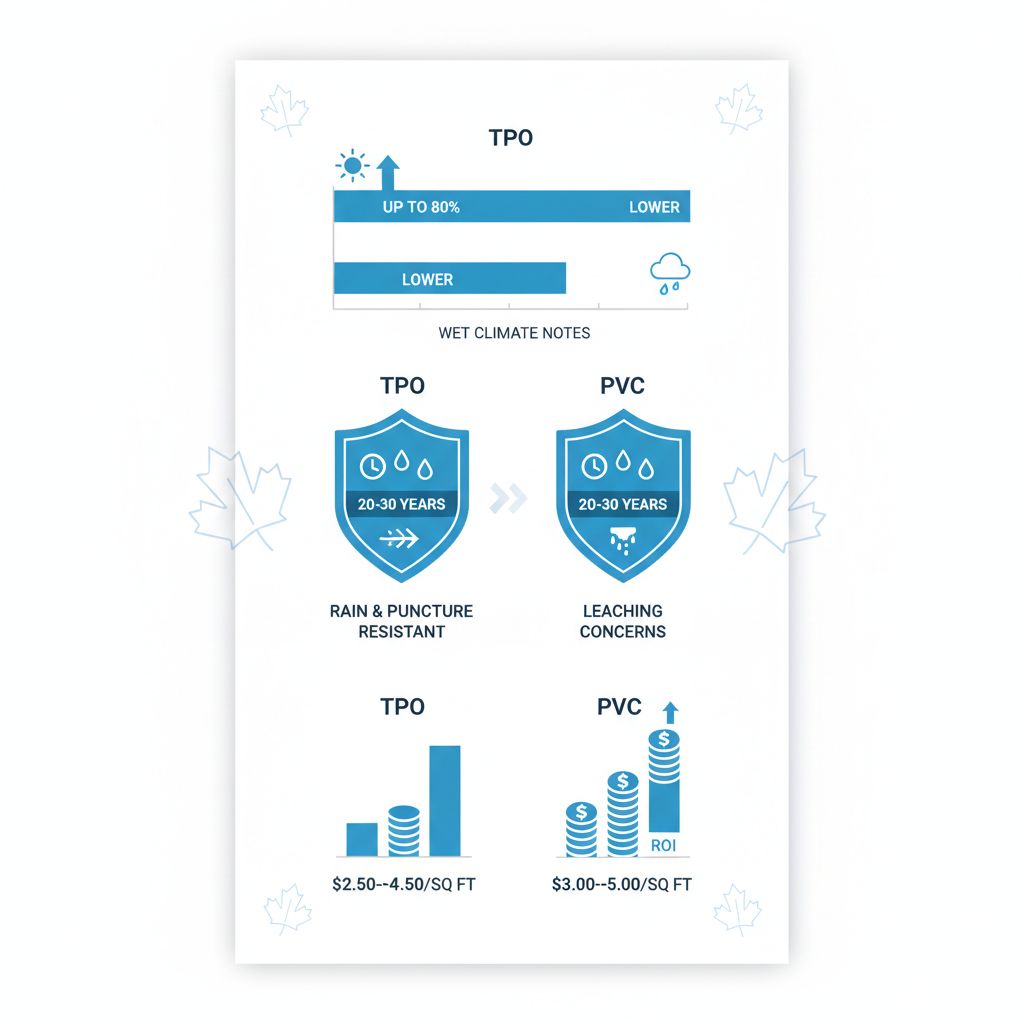
Key benefits comparison of TPO vs PVC roofing for BC coastal properties
Environmental Advantages
TPO roofing supports green building initiatives in BC through its recyclability and low volatile organic compound (VOC) emissions, making it ideal for eco-conscious properties in Vancouver. At the end of its life, the material can be fully recycled, reducing landfill waste compared to non-recyclable alternatives. This aligns with provincial sustainability standards, as seen in our strata council projects emphasizing low-impact materials.
With minimal environmental footprint during production and installation, TPO contributes to LEED certification efforts for commercial buildings in the Lower Mainland. Its energy-efficient design further lowers overall carbon emissions by cutting cooling demands in summer. We prioritize these advantages in our services, ensuring installations meet IIBEC-recommended practices for long-term environmental performance.
- Recyclable thermoplastic construction minimizes waste.
- Low VOCs improve indoor air quality.
- Reflective surface reduces urban heat island effects in BC cities.
How TPO Roofing Systems Function
TPO roofing in British Columbia represents a reliable choice for flat and low-slope roofs, offering durability against the region’s variable weather patterns. As a trusted roofing contractor across British Columbia, we specialize in these seam-welded thermoplastic roofs to protect multi-family and commercial properties. Understanding the mechanics behind TPO systems reveals why they excel in longevity and energy efficiency for structures in Vancouver and the Lower Mainland.
Installation Process
Installing TPO membranes requires precision to ensure a watertight seal, particularly in British Columbia projects where rainfall demands robust performance. We begin with thorough roof preparation, including clearing debris and repairing the substrate to create a smooth surface. This step prevents imperfections that could compromise the membrane’s integrity.
Next, we roll out the TPO sheets, typically 60 to 80 mils thick, across the roof deck. Insulation layers, such as polyisocyanurate boards, are added beneath for thermal efficiency. The sheets are then secured mechanically or fully adhered, depending on the building’s design. Hot-air welding joins the seams, melting the material to form a monolithic barrier. This process, which we execute with specialized equipment, takes about 1-2 days for a standard multi-family roof in our strata projects.
Flashing details around edges and penetrations complete the application, using compatible adhesives. TPO roofing cost typically ranges from $2.50 to $4.50 per square foot, including materials and labor, though estimates depend on site specifics. We strongly advise against DIY attempts, as improper welding can lead to leaks; professional installation by experienced teams ensures compliance with local standards.
Performance Mechanisms
The performance of TPO systems hinges on their ability to handle thermal expansion and contraction, a critical factor in BC’s winters with freeze-thaw cycles. Made from thermoplastic polyolefin, these low-slope system mechanics allow the material to flex without cracking, unlike more rigid alternatives. We leverage this flexibility in our installations to maintain structural integrity over decades.
Hot-air welding creates seams stronger than the membrane itself, resisting water infiltration even under high winds common in coastal areas. The reflective white surface reduces heat absorption, lowering cooling demands in summer—a key advantage in energy-conscious British Columbia builds. For instance, in our Port Moody projects, these mechanisms have demonstrated up to 30-year lifespans with minimal maintenance.
Integration with insulation enhances R-value, promoting uniform temperature control. Analogous to a flexible skin over a building, TPO adapts to movements while providing a seamless shield against UV rays and ozone degradation. This resilience underscores why TPO outperforms in demanding climates, delivering cost savings through reduced repair needs.
Integration with Other Systems
TPO roofing seamlessly integrates with various building elements, ensuring compatibility in Lower Mainland roofs exposed to heavy precipitation. For skylights and vents, we apply pre-formed TPO flashing or custom heat-welded collars to create watertight seals around penetrations, preventing leaks at these vulnerable points.
Drainage systems pair effectively with TPO, where scuppers and internal drains are incorporated during installation to facilitate water runoff on flat surfaces. In multi-family settings, this setup aligns with ventilation requirements, allowing balanced airflow without compromising the membrane.
When considering TPO vs PVC roofing, TPO’s broader welding compatibility simplifies integration with metal edging or HVAC units, avoiding the chemical adhesives sometimes needed for PVC. Our roofing services in Port Moody exemplify this, with case studies showing efficient timelines of 2-3 days for full integrations in commercial strata properties. We maintain liability insurance and WorkSafeBC coverage to safeguard these complex installations, emphasizing professional oversight for optimal results.
Best Practices for TPO Roofing Maintenance and Installation
TPO roofing in British Columbia provides durable protection against the region’s variable weather, but proper installation and upkeep are essential for longevity. We recommend focusing on preventive strategies to address the unique challenges of rainy and temperate climates in areas like the Lower Mainland.
Routine Maintenance Guidelines
We advise bi-annual inspections for TPO roofing systems to ensure optimal performance. Start with clearing debris such as leaves and branches from the surface, which prevents ponding and reduces wear in British Columbia’s frequent rains. Check seams and flashings for cracks, using a soft brush and mild detergent for cleaning to maintain the membrane’s reflective properties.
For installation, ensure proper slope to facilitate drainage, integrating with existing gutters and vents to avoid water buildup. Unlike TPO vs PVC roofing, where PVC may require different chemical cleaners, TPO benefits from simple thermoplastic roof upkeep methods. We offer free on-site inspections at Paragon Roofing BC to assess your system’s condition and provide tailored advice. We also provide roofing services in Coquitlam.
Include these steps in your maintenance checklist:
- Inspect seams and penetrations quarterly.
- Remove debris after heavy storms.
- Test drainage paths annually.
- Document any changes for professional review.
The following table outlines the benefits of routine maintenance versus neglect:
| Action | With Maintenance | Without Maintenance |
|---|---|---|
| Lifespan | 25-30 years | 10-15 years |
| Leak Risks | Minimized through seam checks | High, especially at penetrations |
| Cost | Predictable low annual fees | Unexpected high repair costs |
Common Issues and Solutions
In Lower Mainland environments, TPO roofs often face issues like seam failures due to thermal expansion or punctures from falling branches. Shrinkage can cause wrinkling, while ponding from inadequate slope leads to accelerated aging. We suggest immediate attention to these to prevent leaks.
For seam repairs, clean the area thoroughly and apply a compatible patch kit following manufacturer guidelines. Punctures require cutting out damaged sections and sealing with heat-welded patches. As per RCABC TPO Roof Systems Standard, maintaining seam integrity through regular checks is crucial, as it states that proper adhesion prevents 80% of water intrusion risks.
Budget for repairs by considering TPO roofing cost factors, such as material at $5-8 per square foot plus labor. For example, a small puncture fix might run $200-500, but early detection via our free inspections in Abbotsford and surrounding areas avoids escalation. Always verify warranties, as they vary by manufacturer and product—check terms in your written contract.
Seasonal Care in BC
British Columbia’s seasons demand adaptive care for TPO roofs. In winter, protect against ice dams by ensuring clear gutters and applying anti-bridging membranes during installation. Heavy snow loads require shoveling with caution to avoid membrane tears; we recommend professional assistance for high-risk properties.
Summer brings intense UV exposure, so inspect for granule loss on ballasted systems and reapply protective coatings if needed. This maintains the roof’s white reflective surface, reducing cooling costs in warmer months. Integrate ventilation checks to control moisture, especially in humid coastal areas like Vancouver, BC.
For year-round protection, schedule seasonal walkthroughs. Our team at Paragon Roofing BC provides guidance on these practices, emphasizing estimates subject to on-site inspection. By following these tips, property owners in the Lower Mainland can enhance durability and avoid common pitfalls.
Maximizing TPO Roofing Performance in British Columbia
TPO roofing in British Columbia offers reliable thermoplastic solutions for flat and low-slope roofs, combining durability with energy efficiency tailored to the region’s wet climate. As a single-ply membrane, it provides excellent resistance to UV rays, punctures, and thermal expansion, making it ideal for coastal areas like the Lower Mainland. By recapping its core benefits, such as reduced energy costs through reflective properties and a lifespan of 20-30 years with proper care, we reinforce why this cost-effective flat roofing option stands out for British Columbia properties.
Key takeaways include proactive maintenance to address potential issues like seam failures or ponding water, ensuring long-term performance. When considering TPO vs PVC roofing, TPO often edges out in affordability and heat-welded seams for superior waterproofing, while TPO roofing cost per square foot typically ranges from $5 to $10, depending on project scope. In our experience serving Port Moody and surrounding neighborhoods, these systems align perfectly with local demands for sustainable, weather-resistant coverage.
At Paragon Roofing BC, we invite you to contact us for free on-site inspections to evaluate your roofing needs. Our warranty-backed approach, as a trusted roofing contractor across British Columbia, helps maximize your investment while protecting your home. Building your family’s future starts with perfection in roofing—reach out today for tailored solutions in Vancouver, BC, and beyond.
Resources
- Discover Comprehensive Roofing Materials Services in Vancouver
- Find Climate-Adapted Roofing Solutions for Port Moody Properties
- Explore Sustainable Roofing Installations and Maintenance in Coquitlam
- Obtain Reliable Roofing Services for Abbotsford Properties
- Learn Flat to Low-Slope Roof Conversion Pros and Cons
- Choose Trusted Top Roofing Company in Vancouver
- Get Multifamily Strata Roofing Services in Vancouver Area
- Understand TPO Roofing Systems Standards and Benefits
- Explore Best Practices for Thermoplastic Roofing Installation
